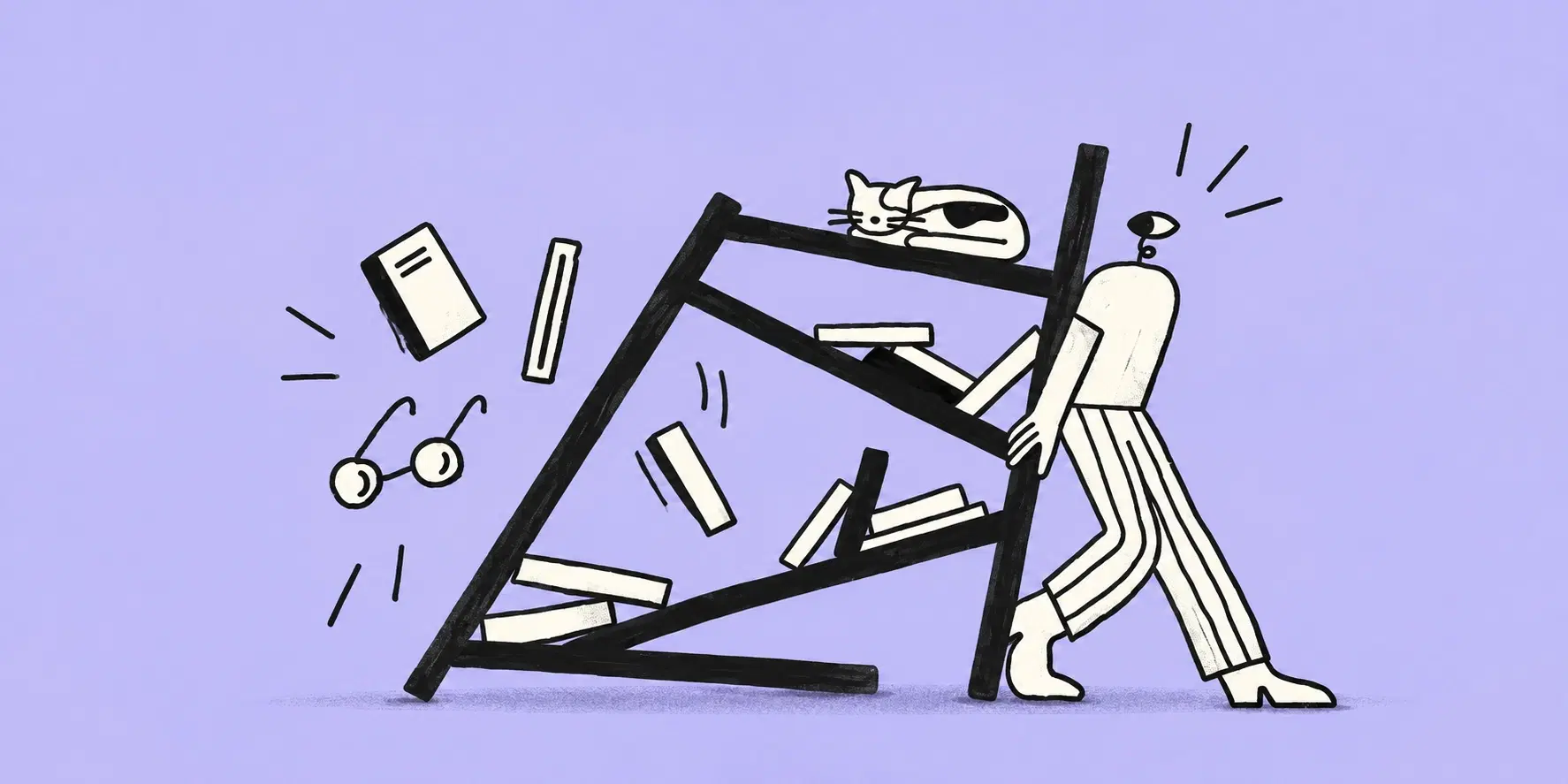
Buying software is usually the sensible place to start. The trouble begins when your business has to keep bending around it.
There is a moment many growing businesses recognise.
You buy software to solve a problem. At first, it helps. The team gets organised, work becomes easier to track, and a process that used to live in spreadsheets finally has a proper home.
Then the business changes.
You add a new service. Your approval process becomes more complicated. A customer expects a different experience. Finance needs the data in another format. A system you already use doesn't quite connect to the new one.
So the workarounds begin.
Someone builds another spreadsheet. Someone pays for an integration tool. Someone copies information between platforms. A manager creates a side process because the official one doesn't quite fit.
The software still works. It just no longer works the way the business needs it to.
This is where the build-versus-buy question becomes interesting. Not when a company is choosing its first tool, but when the cost of working around the tool starts to compete with the value it provides.
The question isn't whether off-the-shelf software is good or bad. It's whether the operational cost of working around the tool is starting to compete with the value it provides.
Typical percentage of a workflow covered by SaaS vs. the high-friction manual tail left behind
Compounding growth of manual spreadsheets and shadow processes as team size doubles
Average timeframe where the cost of workarounds exceeds the full lifecycle cost of purpose-built software
1. Buying is the right answer—until it isn't
Off-the-shelf software exists for good reason. It lets businesses benefit from capabilities that would be expensive and time-consuming to build from scratch. Established products often come with support, security updates, documentation and years of refinement.
If a reliable product solves your problem well enough, buying it is usually the better decision.
A business doesn't gain an advantage by building its own calendar, payroll system or customer database simply because it can. Custom software comes with responsibilities: development, testing, security, maintenance, upgrades and the inevitable work of adapting it as the business evolves.
But buying has a cost that doesn't always appear on the subscription invoice.
It is the cost of compromise.
Perhaps the software handles 80% of your process, but the remaining 20% requires manual work. Perhaps your staff must keep two systems updated because the integrations are incomplete. Perhaps the product forces your team into a workflow designed for a different kind of business.
One compromise may be harmless. A dozen can become an operating model.
The question isn't whether off-the-shelf software is good or bad. It's whether the way your business has to work around it is still worth the trade-off.
Where the Hidden Cost of Workarounds Accumulates
Share of operational drag in organizations operating commoditized SaaS stacks
2. The hidden cost of making software fit
A subscription price is easy to compare. The cost of friction is harder to see because it is scattered across the organisation.
Think about a company that manages customer orders through one platform, inventory through another and accounting through a third. Each system performs its own job reasonably well. But the connections between them are weak.
Staff check stock manually before confirming orders. Finance reconciles transactions at the end of the week. Customer service asks operations for updates that should already be visible. Managers combine exports in spreadsheets to get a reliable picture of performance.
No single task looks catastrophic. Together, they consume time, introduce opportunities for mistakes and make it harder to know what is happening.
The same pattern appears in many industries:
- Diagnostic laboratories: Uses one system for patient administration, separate channels for communication, and manual handoffs to manage reporting and billing.
- Multi-channel retail: Takes orders across multiple platforms but has no dependable way to keep inventory levels and fulfillment state aligned in real time.
- Professional services: Uses project management software that cannot represent its approval governance, forcing operators to manage exceptions in offline spreadsheets.
- Enterprise finance teams: Operates core general ledgers but still relies on manual copy-pasting to collect invoices, reconcile vendor statements, and chase sign-offs.
In each case, the issue may not be that the individual products are poor. It may be that the business needs a connected workflow, while the software has been purchased as a collection of separate tools.
THE BUILD VS. BUY ESCALATION SPECTRUM:

PHASE 1: Standard Utility (BUY)
  [ Payroll / Email / HR ] --------> Off-the-Shelf SaaS (Commodity)
                                     No competitive advantage; zero customization required.

PHASE 2: Hybrid Workflow (INTEGRATE & EXTEND)
  [ CRM / ERP / Data Lake ] -------> Core SaaS Platforms
               |
         (Custom Glue) ------------> ZeroComplex Orchestration Substrate
               |                     (Automates edge cases & reconciles cross-tool data)

PHASE 3: Differentiating Core (BUILD)
  [ Case Triaging / Logistics ] ---> Purpose-Built Operational Engine
  [ Clinical Diagnostic Flow  ]      (Deterministic rules, custom data model, 0 workarounds)
Before deciding to build something, count the workarounds. How much time do they take? How often do errors occur? What gets delayed? Which decisions are made with incomplete information? What happens when the one person who understands the workaround is away?
Those questions turn a vague feeling of frustration into a business case.
3. When should you buy?
Buying is usually the stronger option when the problem is common, the process is reasonably standard, and a mature product covers your needs without forcing costly compromises.
A few signs point towards buying:
- 1The process is not what makes your business different. Payroll, basic accounting, document storage and common collaboration tasks rarely need custom software unless your requirements are unusual or heavily regulated.
- 2The product fits the way you work. Your team can use it without maintaining a shadow process just to fill the gaps.
- 3The cost is predictable. Subscription, implementation and integration costs make sense relative to the value you receive.
- 4The vendor can support the requirements you care about. This includes security, access controls, data export, reliability, support and a credible plan for ongoing maintenance.
- 5You need the capability quickly. Building software takes time. If a reliable product can solve the problem today, the opportunity cost of building may outweigh the benefits.
Buying is not a failure of ambition. It is a way to preserve time and attention for the problems that genuinely need a different answer.
4. When should you build?
Building starts to make sense when the gap between the available software and the needs of the business becomes strategically or operationally significant.
That doesn't mean every inconvenience justifies a custom application. It means there is a point at which adapting the business to the software becomes more expensive than adapting the software to the business.
Look for these critical operational indicators:
- Your workflow is a source of advantage: If the way you deliver a service, fulfil an order, manage a case or coordinate work is central to your value, generic software will struggle to represent it. A purpose-built system supports what makes your business distinctive rather than forcing it into a standard template.
- Workarounds have become permanent: A spreadsheet created to bridge a temporary gap is one thing. A critical spreadsheet that everyone depends on, maintained by one person and updated manually every day, is another. When exceptions become the normal process, it is time to build.
- Your tools cannot share information reliably: Integration can solve many problems without replacing the products involved. But sometimes the workflow crosses so many tools, rules and handoffs that another connector only adds complexity. The right answer is a purpose-built layer that coordinates the work and connects the systems already in place.
- Your requirements don't fit the vendor's roadmap: If a capability is central to your operations but the vendor cannot support it—or has no credible plan to do so—you may be waiting indefinitely for a product to become something it was never designed to be.
- The cost of friction keeps growing: As transaction volumes, teams and service complexity increase, manual workarounds grow non-linearly. What was tolerable for five employees becomes expensive and risky for fifty.
Off-the-Shelf SaaS vs. Purpose-Built Operational Systems
Structural evaluation of commoditized vendor licensing versus proprietary workflow architecture
| Dimension | Off-the-Shelf SaaS | Purpose-Built System |
|---|---|---|
| Core Architecture | Generic schemas designed for thousands of average companies | Tailored domain models built directly around proprietary processes |
| Operational Fit | 70–80% out of the box; remaining 20% handled via manual workarounds | 100% end-to-end alignment without shadow spreadsheets |
| Process Ownership | Business must adapt its operating model to vendor feature roadmaps | Enterprise controls state machines, integration rules, and updates |
| Margin & Unit Economics | Predictable seat-license fees that scale linearly with headcount | Fixed engineering asset; unit cost drops as transaction volume scales |
| Competitive Defensibility | Zero; competitors purchase and deploy the exact same software | High; custom operational tempo creates an uncopyable execution advantage |
5. Build versus buy isn't a binary choice
The decision is often presented as an all-or-nothing binary: buy an existing product or build your own from scratch.
In practice, high-performing architectures occupy the middle ground.
You might keep the core SaaS product and integrate it with the other tools you use. You might build a small internal application around it. You might replace one part of the workflow while leaving the rest alone. Or you might create an underlying system that coordinates several existing platforms.
This is often the most sensible route: keep buying the capabilities that are already solved well, and build only where the business has a meaningful operational gap.
For example, an enterprise may not need its own accounting software. It may need a system that gathers information from operational tools, prepares transactions for accounting, flags exceptions, and passes clean data to its existing accounting platform.
A diagnostic laboratory does not need to replace every instrument software. It needs a connected operational substrate that brings patient intake, worklists, reporting, communication, and billing into a coherent autonomous loop.
The point is not to own every line of code. It is to make the overall system work.
6. The five questions to answer before committing
Before buying another subscription or commissioning a custom build, bring the operators who do the work into the room and answer five questions:
- 1What is the actual problem? Describe the work that is delayed, repeated, or difficult—not just the cosmetic feature you wish a product had.
- 2How much does the current workaround cost? Include staff time, rework, errors, delays, integration fees, and the strategic consequences of poor visibility.
- 3Can an existing product solve it properly? Assess the real workflow, not just the vendor's demo. Test the awkward edge cases as well as the happy path.
- 4What is the smallest useful change? It may be a configuration change, a better integration, or a focused custom module rather than a complete platform replacement.
- 5Who will own it over time? Every option needs someone responsible for security, access controls, support, updates, data quality, and failure recovery.
A custom build should have a clear reason to exist and a plan for its entire lifecycle. A purchased product should be assessed on its total operational cost and fit, not just its monthly subscription invoice.
Neither decision is complete until you understand how the solution will be maintained and how you will measure its ROI.
The right software should reduce the work around the work
There is no prize for building software that already exists. Nor is there much value in continuing to pay for a system that forces your team to spend every day compensating for its limitations.
The best decision starts with the business problem, not an ideological preference for buying or building.
Buy when a proven product fits. Integrate when the tools are good but disconnected. Build when the way your business needs to operate cannot be supported well by what is already available. Your business shouldn't have to become a workaround for its own software.
At ZeroComplex, we work with businesses to identify where commoditized SaaS falls short and engineer purpose-built operational systems that make real work happen. Sometimes that means connecting existing platforms with resilient event backbones; sometimes it means orchestrating autonomous workflows around them. And when your proprietary process demands a custom capability off-the-shelf software was never designed to solve, we build the dedicated software that turns your operational complexity into an enduring competitive advantage.